Pradosha pooja is one of the most sacred and
important according to PRADOSHA PURANA.
Once the gods (Devas) and the demons (Asuras) were
churning the milky ocean with the help of Vasuki, the serpent
king, hoping to extract amrtam (nectar) from the Kseerabthi
(milk ocean). Vasuki who was employed as a rope for churning,
endured severe abrasions and strangulation. Thereupon, she spewed
halahalam, a potent dark poison capable of destroying the
worlds. Threatened by the scorching venom, the celestials fled in
great horror. Brahma took to His heels. Vishnu’s bluish body
darkened further. Indra could not be seen. Agni, the
fire god, could not bear the raging heat. Yama ran amuck
in all directions. Varuna became unconscious, Kubera
fled. Hosts of siddhas, Caranas, Gandharvas, Yakshas
and Maharshis went to Kailasa and sought the Lord’s
feet as refuge.
God Shiva was moved with pity at their plight and was overcome
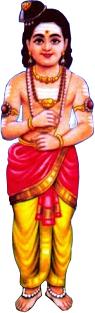
with compassion by their prayers. Soon He bade Sundara for
a prompt intervention, who then rushed to the ocean, collected the
all-pervasive poison and holding it in his hand as a small jambu
fruit, returned to Kailasa. The Lord became exceedingly
happy after seeing it. He showed it to Girija and gave the title
‘Halahala’ to Sundara, who thenceforth came to be known as Halahala
Sundara. Thereupon, the Lord accepted the Halahala pellet from
his hand and, with the loving permission of Universal Mother, swallowed
it. By goddessUma’s command, the pellet froze in the Lord’s throat,
painting it blue and becoming an embellishment, gave Him the name
NilakanTa. [It is also a common practice for womanhood to worship
Goddess Parvathi for long life of Husbands as She is having ‘Maangalya
Baagyam’ and could turn the poison into nectar].
On Trayodhasi(thirteenth moon
day) they realised their sin of not praying the God and pleaded
for forgiveness. The pleased graceful Lord Shiva forgave them and
danced between the horns of the Nandhi (Holy Bull). That time is
called Pradhosham. Whoever Prays Lord Shiva in that time, Lord Shiva
fulfills their wishes and give them mukthi. Anoint Lord Shiva
with Love, He would give Himself!
Among the poojas performed by Shaivites to the Graceful Lord
Shiva. In Shukla Paksha (15 moon days from new moon to full moon)
and Krishna Paksha (15 moon days from full moon to new moon) the
evening of the Trayodasi
(thirteenth moon day) between 4.30 pm to 6.00 p.m. is called "Pradosham".
It comes once in fifteen moon days. Pradosha time is to Pray Lord
Shiva and invoke His Blessings. Praying in this time will free us
from sins and gives Moksha (hence the name Pradosha).
During Pradosha time, a special type of circumambulating called
("Somasutra Pradakshinam) which is elaborated in this site
separately.
During Prodhosha time anointing (Abhishekam) the Shiva deity
with the Following is considered fruitful.
Somasuthra Pradakshinam is a unique way of
circumambulating the GOD.
First saluting the Rishabha Devar (Holy Bull or Nandi)
go anti-clockwise and salute Chandishwarar (not crossing the Gomukhi).
Now return in the clockwise manner salute Rishabham and continue
clockwise till the Gomukhi (not to cross it again). Then return
in anti-clockwise direction salute the Rishabham again and proceed
towards chaNdIshar. From there return back clockwise without worshiping
Rishabham and reach the Gomukhi. Finally return back anticlockwise
from there to salute Rishabham and continue to Chandishwarar and
return back to Rishabham and worship the Shiva Lingam (at the altar)
by viewing through the space between the two horns of the Holy Bull.
This is one Pradakshinam. Three such times Pradakshinam to be done.
If you carefully observe the curve traced by doing the pradakshinam
is very similar to the periphery of the crescent. Hence this way
of circumambulating is called Somasutra Pradakshinam.
During the pradhosham time Somasootra
Pradakshinam is the recommended way of circumambulating
the God. In many of the temples this is
followed always. A point to note here is
that the gomukhi is never crossed.
gomukhi is the place where the water after
anointing (abhiSheka theertham) would be flowing
northwards out. By doing this way of
Pradakshinam
one does not step over this holy water.
As per the above marked symbols this
Pradakshinams is to be done. First saluting
the R^iShabha devar (Holy Bull) go anti-clockwise
and salute chaNdIshar (not crossing the
Gomukhi). Now return in the clockwise manner
salute VruShabham and continue clockwise
till the Gomukhi (not cross it again).
Then return in anti-clockwise direction
salute the RiShabham again and proceed towards
Chadeeshar. From there return back
clockwise without worshiping Rishabham and reach
the Gomukhi. Finally return back
anti-clockwise from there to salute Rishabham and continue
to chandIshar and return back to Rishabham
and worship the Shiva Lingam (at the altar)
by viewing through the space between the
two horns of the Holy Bull. This is one
Pradakshinam. Three such times
Pradakshinam is to be performed.
If you carefully observe the curve traced
by doing the Pradakshinam is very similar
to the periphery of the crescent. Hence
this way of circumambulating is called
Somasutra Pradakshinam.
The following is the illustration of how you should perform
Somasutra Pradakshinam :
SOMASUTRA PRADAKSHINAM (This is
performed only during Pradosha Kalam)

|