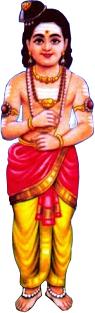
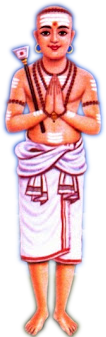
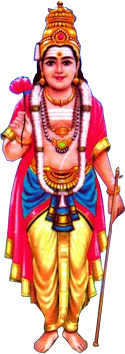
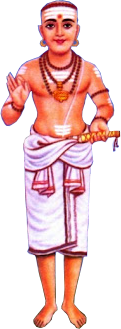
Thirugyanasambandar was born to serve God Shiva and
spread His glory. Considered one among the most revered
four Samayakkuravarkal (dedicated servitors of Lord Shiva),
Sambandhar was born as an avatar of
Lord Subramanya in
Seerkaazhi. He was born in a Brahminical family, His
father's name was SivapAdahraya - meaning 'the one with the Lord's
Feet in his heart' and His mother was Bagavat
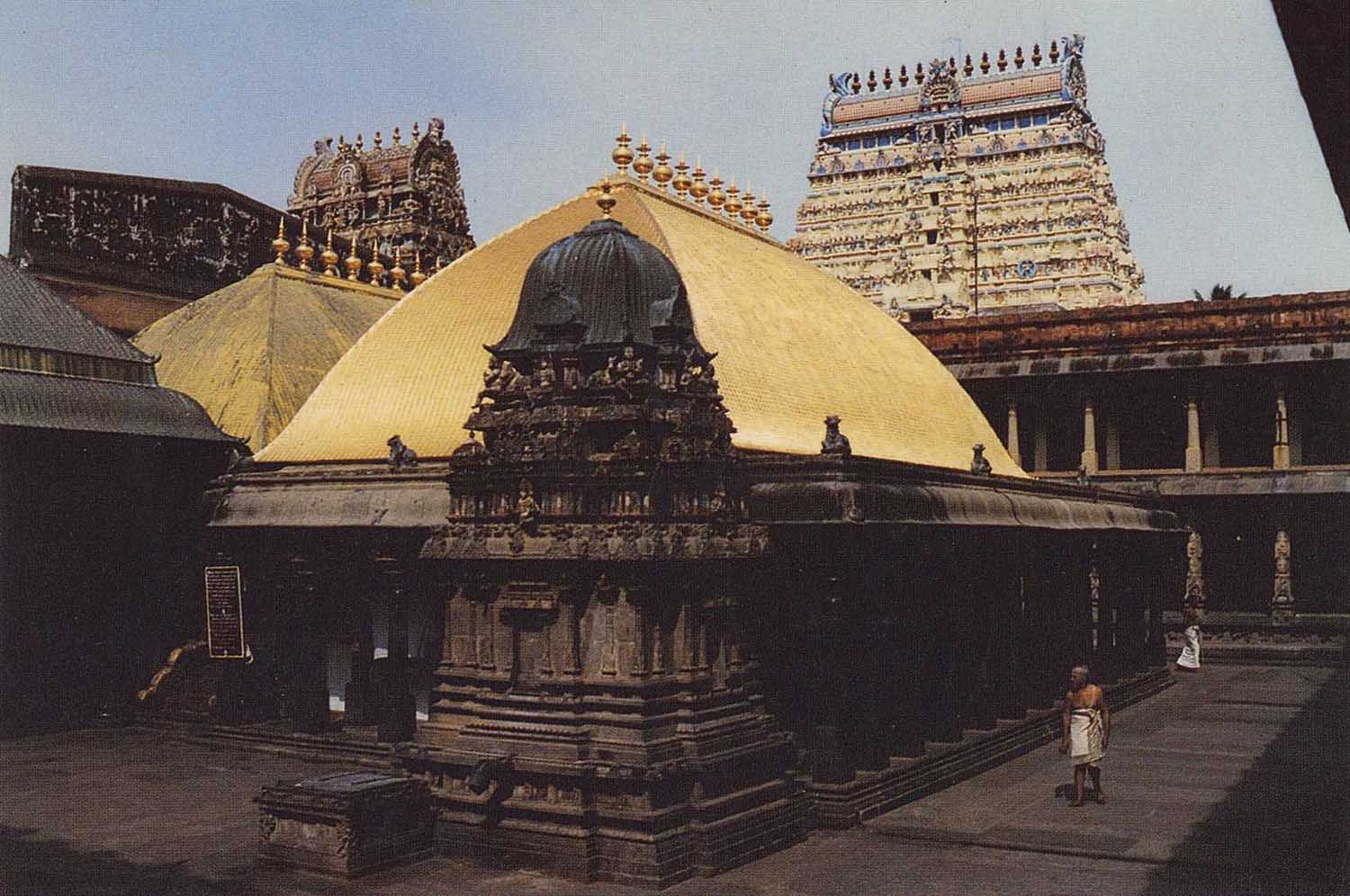
Situated between the perennial River
Cauveri and the 'Golden Hall' Chidambaram, was a village by
name Brahmapuram. It was variously referred to as
Vrsadhvajapuram, Venupuram hallowed place was it, that it withstood
cosmic dissolution under Shiva's protection.
Its dense vegetation included mango
and jackfruit groves and areca palms, which formed a
protective green girdle around the place. These plantations and the
lush green meadows provided a serene and picturesque and the lush
green meadow provided a serene and picturesque backdrop to the
village. The vast paddy fields irrigated by the Cauveri waters
formed an inexhaustible resources of food for all. White lotuses and
blue lilies filled the lakes, supplying food day and night for the
nocturnal and diurnal birds and insects. Animals, wild and
gentle, lived in harmonious co-existence.
In such a village, where everyone
performed his ordained duties in joyous devotion, a Brahmana lived a
life committed to the orthodox ways of Shiva worship. His name
was
Sivapadahrdaya, (the one with the Lord's feet in his heart).
By his exemplary discipline be became an object of adoration for
everyone and shone as a repository of peace, love and vedic
knowledge. This scion of the Kaundinya lineage was married to the
noble Bhagavari
who was an embodiment of peace, piety and humility.
Together they reveled in the loving service and worship of the
loving Lord. Their house was a haven for everyone, be it ascetics,
beggars or even strangers. The couple was content in almost every
aspect. The lack of an issue prompted them to direct their
so-far-selfless service and worship to the Lord for begetting a
child. Those times were not propitious for the votaries of Shiva and
the saiva-vaidika dharma suffered a total deluge caused by the
delusive and stony alien faiths like Jainism and Buddhism. So,
Shivapadahrdaya resolved to propitiate Shiva to grant him a son
who would obliterate to wicked cults and firmly reestablish the
hoary path of Shaivism. The couple undertook severe
austerities and elaborate rituals to appease the Lord of Thonipuram.
Shivapada
himself worshipped the Shivalingam with three thousand Drona
flowers and performed one hundred circumambulations to the temple
everyday. Salt which promotes the wavering and dullness of the mind
was completely omitted from the diet. Their already slimmed
bodies - from frugal eating - were emaciated all the more.
Thus did they discipline their bodies
and minds for three years, but to no avail. Then, the much-depressed
Bhagavati undertook prayopavesha (fast unto death) in the Lord's
presence. That very night Shiva, in a dream blessed her with a
golden bowl of sweet rice dish, which she readily consumed with
delight. The food of grace fulfilled her yearning. She soon became
pregnant. The joy of couple was boundless. Their devotion to
the Lord became all the more fortified.
Then on an Ardra day, when the Jupitar
was conjoined with the moon, Bhagavati gave birth to a resplendent
baby boy like mother Gauri to Subrahmanya, the vanquisher of non
Vedic faiths. Many auspicious signs appeared to the Saivites while
bad omens rained on the Pasandas (Jains and Buddhists.) It was a
moment of celebration for mortals as well as celestials. Mother
nature suddenly acquired new blues and fresh fragrance. Cows yielded
milk in abundance. Cuckoos sang in chorus as though it were spring.
Peacocks danced in mirth thinking that the boy was verily a
manifestation of their master Skanda. Vedic pundits felt a surge of
new vigor and ecstatic pride, as sama chants spontaneously sprang
forth from their throats. Evidently, it was the dawn of a new era of
resuscitation for the Vaidika dharma in general and Siva Sampradayam
(tradition) in particular, and the Uttar rout of those
spreading perverse doctrines.
Sivapadahrdaya gave away gifts
of cows, gold and grain to pious Brahmanas and the needy. On an
appropriate day he named the baby as Jnana Sambandha one
related to knowledge in an elaborate ceremony. Multitudes partook of
the feeding thereof. His gestures, however tiny, were symbolic of
his life mission of flushing out and crushing the anti Vedic
elements, and to solidly re-establish the timeless Saiva Sanatana
Dharama. The boy grew up like the waxing moon, passing quickly
through the preliminary stages of babyhood. While the father
ceremoniously adorned his forehead with the three stripes of the
sacred ash, the mainstay of Sivabhktas, the child avidly watched him
with pleasure and concentration. Again while his mother nursed him
and sang in devotion, he often seemed to be lost in his own
thoughts, his mouth agape.
On his first birthday he saw the
sumptuous feeding of friends and relatives. The father now started
taking him to a stream nearby to bathe. The father now started
taking him to a stream nearby to bathe. He would chant from the
Vedas and worship the Lings, with proper pace and articulation, so
that the boy could appreciate them. Thus, in the constant intimacy
with his noble and wise father, Jnana Sambandha silently assimilated
many points relating to the traditional ways of worship and
communion.
Soon, the boy grew up into a three -
year-old toddler, tottering about the house with his anklets
tinkiling synchrony with the Vedic chants. His earrings shining, he
seemed like an avatara of Subrahmanya condescended to fulfill
his father's mission.
It was dawn in Dhanurmasam (December-Januray)
Sivapadahrdaya set out early to the
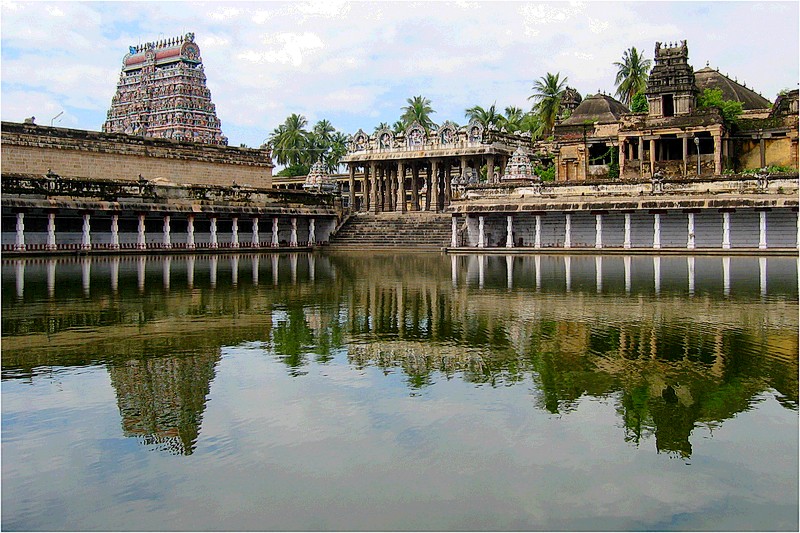
nearby temple of Brahmapurisvara for performing his morning
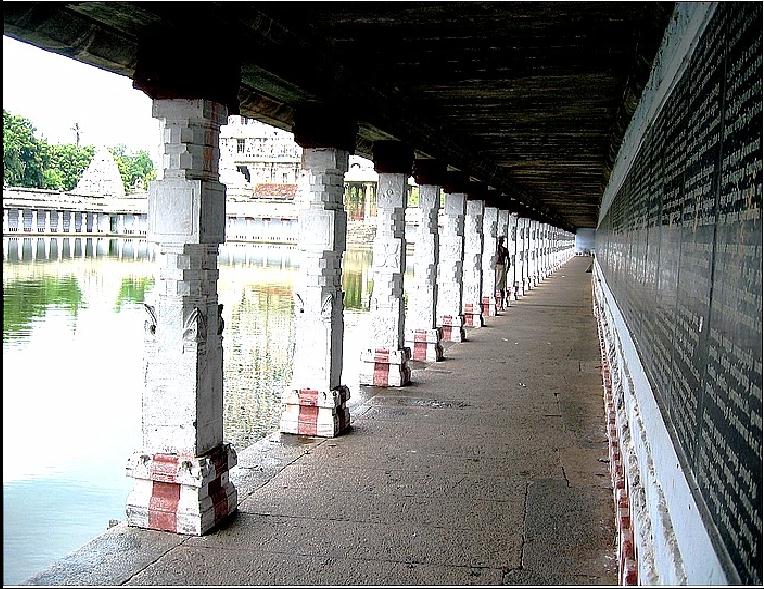
ablutions in the Pushkarini (temple tank). Was this to be the role
of the Lord's grace to be bestowed on the child Sambandha? he sprang
up from the bed and followed his father. Unable to dissuade him,
Sivapada carried him along. He seated the boy on the upper steps and
entrusting him to the Lord's care, he descended into neck deep
waters for performing the ordained rites. First, he bathed chanting
the Aghamarshana suktam. Then while mentally reciting the 'Purusha
Suktam, he performed pranayama by completely immersing himself in
the water. The boy Sambandha had all along been watching his
father's actions with a keen eye and a heart fill of devotion. Now,
unable to see his father for a while he looked around for him in
fear. Then crying aloud 'O father, O mother, 'he cast all his
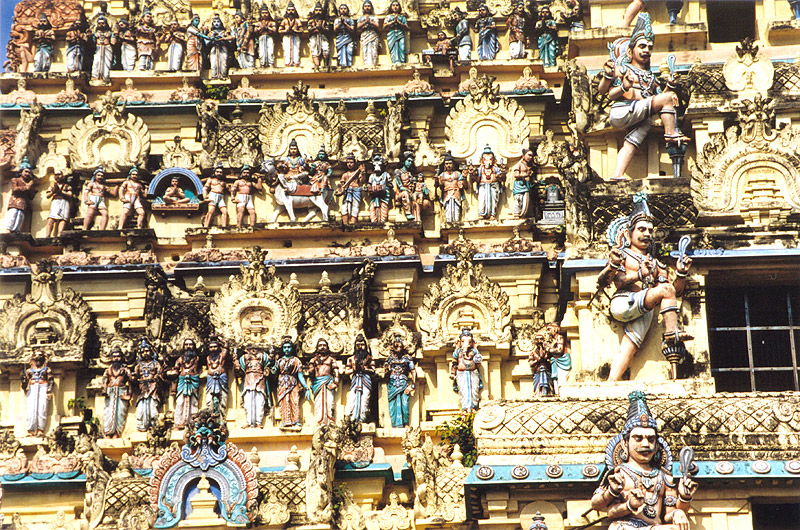
attention on the nearby temple tower. Could it have been an
inadvertent act?. Was it not but the sportive design of the Lord,
whose ways were inscrutable? it was as though the Lords had been
anxiously waiting on hi toes for this lobbing 'call' from His son.
No sooner the boy cried thus, than the
Lord Siva, the one who is readily pleased - Austosha - appeared
along with the Universal Mother seaterd on Nandi, the sacred bull.
All the quarters were filled with
etheral brilliance in which the sunlight was derowned.Pointing to
the crying lad, Shiva said to His lady. "Gauri! Look at our baby,
with eyes as pretty as lotuses. He seems to be lost and needs to be
comforted. You can please me by blessing him with a taste of your
breast milk, which is but amrutam and the sole privilege of
Skanda and Vinayaka. "was not the Mother eager to flood the boy's
heart with her love, and only waiting for the Lord's world? Had She
not Herself, of yore won the Lord's heart thus? Yes! Her heart
brimmed with tender love and her breasts with milk. She lifted the
boy, wiped his tears, kissed his forehead and laid him on her lap.
In a trice, She produced a gold cup and filled it with her milk. Was
it not this milk that had given rare wisdom and devotion to Ganesha
and Guha? As she logingly offered the cup, Sambadha eagerly held it
to his rosy lips and imbibed the milk to the last drop. The food of
Grace unavailable even to celestials, was the bestower of true
knowledge and rare wisdom, and would put to flight the fear of the
vicious cycle of birth and death.
What is birth? ' I am the body' thought
What is death? ' I am the doer' notion
What is true knowledge? the knowledge of one's Self
What is rare wisdom? That the Lord is the beginning, middle
and end of all, and their cause.
- so say the sages!
Sambandha beamed with content and his
heart overflowed with love for the divine parents. Lord Shiva
and Parvathi returned to their abode towards the tower and beyond as
their mission was complete. Sivapadhyrdaya who had been in a
different mode and mood of worship was unaware of this wondrous
spectacle. His ritual drawn to a close, he emerged from the
tank and saw his son's face radiating bliss par excellence.
There were streaks of milk around his rosy lips and his hands
clasped the golden receptacle in sweet gratitude. The father
wondered at this sight and questioned in a harsh tone: "Darling! Who
gave you the milk, the traces of which I see on your cheeks? Tell me
now".
This sharp query evoked, in reply, a
perennial spring of sweet and chaste Tamil poetry to gush forth like
the surging Ganga from the boy's mouth, originating from deep within
his heart. It was to flow spontaneously and un-intermittently
all through his life, inspiring the multitudes ever after. As
a response to this father's enquiry he pointed to the temple tower
where the Universal Parents had disappeared after blessing him with
the milk of knowledge. The father was unable to find anything
other than the tower. In a soul stirring decad, Sambandha
described the various insignia and embellishments of the Divine
Parents, starting with the dangling earring of the Lord. (thodudaiya
cheviyan as described in the beginning). He made it clear that
it was the gracious act of the Lord and His Lady that put an end to
his dark nescience and the cycle of fearful and painful births.
Flowers showered on the boy from the
heavens and the quarters thundered in approval. The father
feared that it was all the workings wrought by some evil spirit.
He smeared the sacred tripundra bhasma on the boy's forehead
and pressed him for the truth. Sambandha continued to reply in
the same strain - to the wonderment of not only his father but also
many others who had by now gathered around.
THE BOY SANG :
"Your body is adored by the Lady (Ardhanarishwara)
and Your Lotus Feet
are an object of adoration for those who are proficient
in Samskrutam, such
as Brahma and Ohters. He that has the Ganga
arrested in His matted locks,
the presiding Lord of
Dronipura (Thonipuram) I submit my adoration"
O Lord of
Gods! The Supreme One! I, the sone of Gauri, supplicate You
who are omnipresent and omnicient. Hence,
whatever is said of You
can at best be incomplete, if not untrue. Pray
forgive this vocal offence
of mine, Ocean of compassion that You are!
O Lord of
Gods! The Supreme One! I, the sone of Gauri, supplicate You
who are omnipresent and omnicient. Hence,
whatever is said of You
can at best be incomplete, if not untrue. Pray
forgive this vocal offence
of mine, Ocean of compassion that You are!
You are famed
as and supreme by the virtue of the art of liberation;
the taintless; ever-revelling in the subjects of Vedas
and Agamas; the
uplifter of all the worlds; the best and the foremost;
the one whom one's
all the worlds; the best and the foremost; the one in whom
one's trust
can be moored in peace; the protector of Venupuram.
You are proclaimed by the Vedic scriptures; the subduer of
Tripurasuras;
bestower of boons; above the qualities of sattva, etc. the
one Lord
that became the trinity - Brahma, Vishnu and Rudra; the
ordainer of the
triad - meditator, meditation and the object of medication;
the king of
the three worlds - earth, heaven and the nether world.